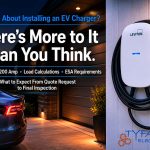
EV Charger Installation in Ottawa: What to Expect From Quote Request to Final Inspection
As electric vehicle ownership continues to grow across Ottawa, more homeowners are looking to install a Level 2 EV charger at home.
One of the most common questions we receive is:
“How much will it cost?”
The honest answer is that every installation is different. Before we can provide an accurate quote, we need to understand your home’s electrical system, the charger you intend to install, and the route required to get power from your electrical panel to your vehicle.
Buying an EV is easy. Installing a Level 2 charger can be straightforward too — but the cost, complexity, and timeline can vary significantly depending on your home’s electrical system.
Some homeowners can install a charger with minimal modifications.
Others may require load management, service upgrades, or more complex wiring routes.
Understanding the process ahead of time helps avoid surprises and ensures you receive an accurate quote.
Here’s what the process typically looks like.
Step 1: Request a Quote
The process begins with a quote request.
To provide an accurate estimate, we’ll typically ask for:
- Photos of your electrical panel — including a clear photo of the breakers and a wider photo showing the panel and surrounding area
- Photos of where you would like the charger installed
- Photos showing possible cable routing paths between the electrical panel and charger location
- Information about whether the basement or areas along the proposed wiring route are finished or unfinished
- The make, model and specification sheet for the EV charger you plan to install
- For homes with a 100-amp electrical service: the highest hourly electricity usage from the previous 365 days
This information helps us evaluate your electrical service and the requirements of your charger. It also helps us identify possible wiring routes and installation challenges before preparing your quote.
Step 2: Understanding Your Electrical Service
One of the biggest factors in an EV charger installation is your home’s electrical panel capacity.
The Question We Get Asked Most
Can I install an EV charger on my existing electrical service?
In many cases, yes. The answer depends on your electrical service, your home’s existing demand, and the charging equipment you plan to install.
100-Amp Service
Many older Ottawa homes have a 100-amp electrical service.
Having a 100-amp service does not automatically mean you need to upgrade to a 200-amp service to install a Level 2 EV charger. The home’s existing electrical demand must first be evaluated.
For EV charger installations on a 100-amp service, the Electrical Safety Authority (ESA) requires the home’s highest hourly electricity usage from the previous 365 days as part of the load assessment.
This historical usage helps determine how much electrical capacity may be available for EV charging.
If the assessment shows sufficient capacity, the existing 100-amp service may be able to support the proposed charger.
If there isn’t sufficient capacity, there may still be several options:
- Installing a lower-amperage charger or reducing the charger’s configured output
- Using an approved EV energy management system, such as a DCC
- Upgrading the electrical service to 200 amps
A 200-amp service upgrade isn’t always the only solution. The right option depends on the home’s electrical demand, the charger being installed, the electrical panel and the overall installation.
200-Amp Service
Homes with 200-amp service generally have more available capacity for EV charging.
While a load calculation may still be required, many installations can proceed without major electrical upgrades.
That said, every home is different, and assumptions should never be made based solely on service size.
Step 3: Site Visit
Depending on the information provided, we may recommend a site visit.
During the visit, we’ll assess:
- Electrical panel location
- Charger location
- Cable routing options
- Finished versus unfinished spaces
- Accessibility
- Potential obstacles
- Future expansion opportunities
This allows us to provide an accurate scope of work and avoid surprises during installation.
Step 4: Planning the Wiring Route
The routing path is often the biggest factor affecting installation cost.
Some common scenarios include:
Unfinished Basement
Typically the most straightforward installation.
Wiring can often be routed through exposed joists, reducing labour and material requirements.
Finished Basement
Additional planning may be required to conceal wiring or minimize wall repairs.
Garage Installations
We evaluate whether wiring can be routed through the garage walls, attic spaces, basement ceiling, or exterior surfaces.
Exterior Runs
In some cases, surface-mounted conduit may be the best solution.
When installed properly, conduit provides a clean, professional appearance while protecting the wiring from damage.
Step 5: Plug-In or Hardwired?
Many EV chargers are available in either plug-in or hardwired configurations.
Plug-In Chargers
Advantages:
- Easier replacement in the future
- Portable if you move
Considerations:
- Requires a properly installed receptacle
- May have limitations depending on charger specifications
Hardwired Chargers
Advantages:
- Permanent installation
- Often preferred by manufacturers
- No receptacle required
Considerations:
- Charger removal requires electrical work
The best choice depends on your charger, installation location, and future plans.
Step 6: Permit and Inspection
EV charger installations require an electrical permit.
Once the installation is complete, the Electrical Safety Authority (ESA) performs the required inspection to ensure the work meets Ontario electrical safety standards.
This provides peace of mind that the installation has been completed safely and correctly.
Step 7: Charge and Enjoy
Once the installation has passed inspection, you’re ready to enjoy the convenience of charging at home.
For most EV owners, a Level 2 charger dramatically reduces charging times compared to a standard household receptacle and makes daily charging simple and reliable.
EV Charger Installation FAQ
Do I need a permit to install an EV charger in Ottawa?
Yes. EV charger installations require electrical work that must comply with the Ontario Electrical Safety Code. TYFAR coordinates the required ESA permit and inspection process.
Can I install an EV charger on a 100A service?
Yes, many homes with a 100A electrical service can support a Level 2 EV charger.
For a 100A service, we require the home’s highest hourly electricity usage from the previous 365 days as part of the load assessment. If sufficient capacity isn’t available, load management or an electrical service upgrade may be considered.
Should I choose hardwired or NEMA 14-50?
Both options have advantages. We help homeowners determine the best solution based on charger type, future flexibility, and installation location.
How long does installation take?
Most residential EV charger installations can be completed in a single day. More complex installations may take longer depending on the electrical work and wiring route required.
Can TYFAR install an EV charger I already purchased?
Yes. We can install customer-supplied EV chargers provided the equipment is approved for use in Canada and suitable for the intended installation.
Ready to Install an EV Charger?
To help us provide an accurate quote, please include:
✓ Photos of your electrical panel
✓ Photos of the desired charger location
✓ Photos showing possible wiring routes
✓ Charger specifications
✓ Information about your electrical service
The more information you provide upfront, the faster we can review your project and determine the safest, most practical, and most cost-effective installation approach.
Our licensed Ottawa electricians will review the information provided and determine whether a site visit is required before preparing your quote.
Ready to get started? Request your EV charger installation quote today.