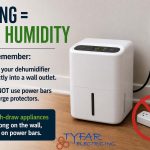
Spring hits, the snow melts, and suddenly your house feels damp.
So people grab a dehumidifier and plug it in without thinking — but dehumidifier power bar safety is something most homeowners overlook, and it can lead to bigger problems.
Dehumidifier Power Bar Safety: The Mistake Most People Make
It seems harmless:
Dehumidifier → power bar → good to go
Except it’s not.
A dehumidifier isn’t like a phone charger or a TV. It’s a high-draw appliance — meaning it pulls a steady amount of power over long periods of time.
Power bars (even surge protectors) aren’t designed for that.
Why This Is Actually a Problem
When you run a dehumidifier through a power bar, you’re introducing weak points into the system.
Here’s what can happen:
- Heat buildup inside the power bar
- Connection stress from constant load
- Voltage drop affecting performance
- Fire risk in worst-case scenarios
And the worst part?
It doesn’t fail instantly.
It builds over time — quietly.
“But It’s a Surge Protector — Isn’t That Safer?”
Nope.
Surge protectors are built for:
- Electronics
- Short bursts of protection
Not:
- Continuous heavy loads
- Motors and compressors
They don’t reduce load — they just add another connection point.
More connection = more resistance = more heat.
The Rule Is Simple
If it:
- Has a motor
- Creates heat
- Runs for long periods
Plug it directly into the wall.
No power bars.
No extensions.
No shortcuts.
Other Appliances This Applies To
It’s not just dehumidifiers:
- Space heaters
- Window AC units
- Microwaves
- Fridges & freezers
Same rule across the board.
Quick Reality Check
A lot of electrical issues don’t start as “big problems.”
They start as:
- Slight heat
- Minor stress
- Small compromises
…and then one day, something fails.
Bottom Line
Spring humidity isn’t the problem.
How you power your equipment is.
Plug your dehumidifier directly into a wall outlet.
It’s the simplest way to avoid a much bigger issue later.
For more general electrical safety guidance, visit the Electrical Safety Authority (ESA).